NEW · THE AI MARKET LENS · WEEKLY BRIEFING · 8 NOVEMBER 2026
The AI Market Lens — Weekly Briefing: The Packaging Bottleneck
# The AI Market Lens — Weekly Briefing: The Packaging Bottleneck
Sunday-to-Sunday edition · 1–8 November 2026
AI infrastructure is often described as a race to secure the fastest processors. This week’s evidence points to a less visible part of the production line: fitting processors, memory and other components together into a working package at scale. The chip gets the headline; the package does a lot of the quiet logistics.
The signal is not that advanced packaging has suddenly replaced chip fabrication as the industry’s main constraint. It is that packaging capacity is becoming a strategic part of the AI supply chain, and companies are beginning to spend, partner and plan around it. In chip manufacturing, bottlenecks have a habit of moving just as everyone learns the previous one’s name.
What moved this week
AMD reported record third-quarter revenue of $13.4 billion, up 45% year over year, and said its data-center segment reached $8.5 billion, up 97%. The company attributed the result to demand for Instinct accelerators and EPYC server processors. It forecast fourth-quarter revenue of about $17 billion, plus or minus 3%. These are company-reported figures and guidance, not an independent forecast. (AMD’s results)
Two days later, Reuters reported that demand for AI processors is running into advanced-packaging capacity limits. Its reporting described a scramble by chip designers and suppliers to expand capacity and seek alternatives. Reuters cited Yole Group’s estimate that advanced-packaging revenue could exceed traditional packaging revenue for the first time in 2026, with industry capital spending approaching $28 billion. Treat those figures as an industry forecast, not audited company spending or a guaranteed outcome. (Reuters, 6 November)
The same report said an unnamed industry executive described Nvidia as financing billions of dollars of CoWoS capacity expansion at ASE Technology’s SPIL unit. Nvidia did not comment to Reuters, while ASE declined to comment on customer-market rumours. This remains an attributed report, not a confirmed investment announcement, so it should not be treated as an established transaction.
There is, however, public evidence of the wider expansion. AMD announced in May that it planned more than $10 billion in investments across Taiwan’s semiconductor ecosystem, including partnerships involving advanced packaging. ASE has separately announced a NT$17.6 billion advanced-packaging facility, then scheduled for completion in the first quarter of 2028. The two announcements show long-horizon capacity plans; they do not prove that the industry can remove near-term constraints quickly. (AMD announcement; ASE facility announcement)
Why packaging matters to AI chips
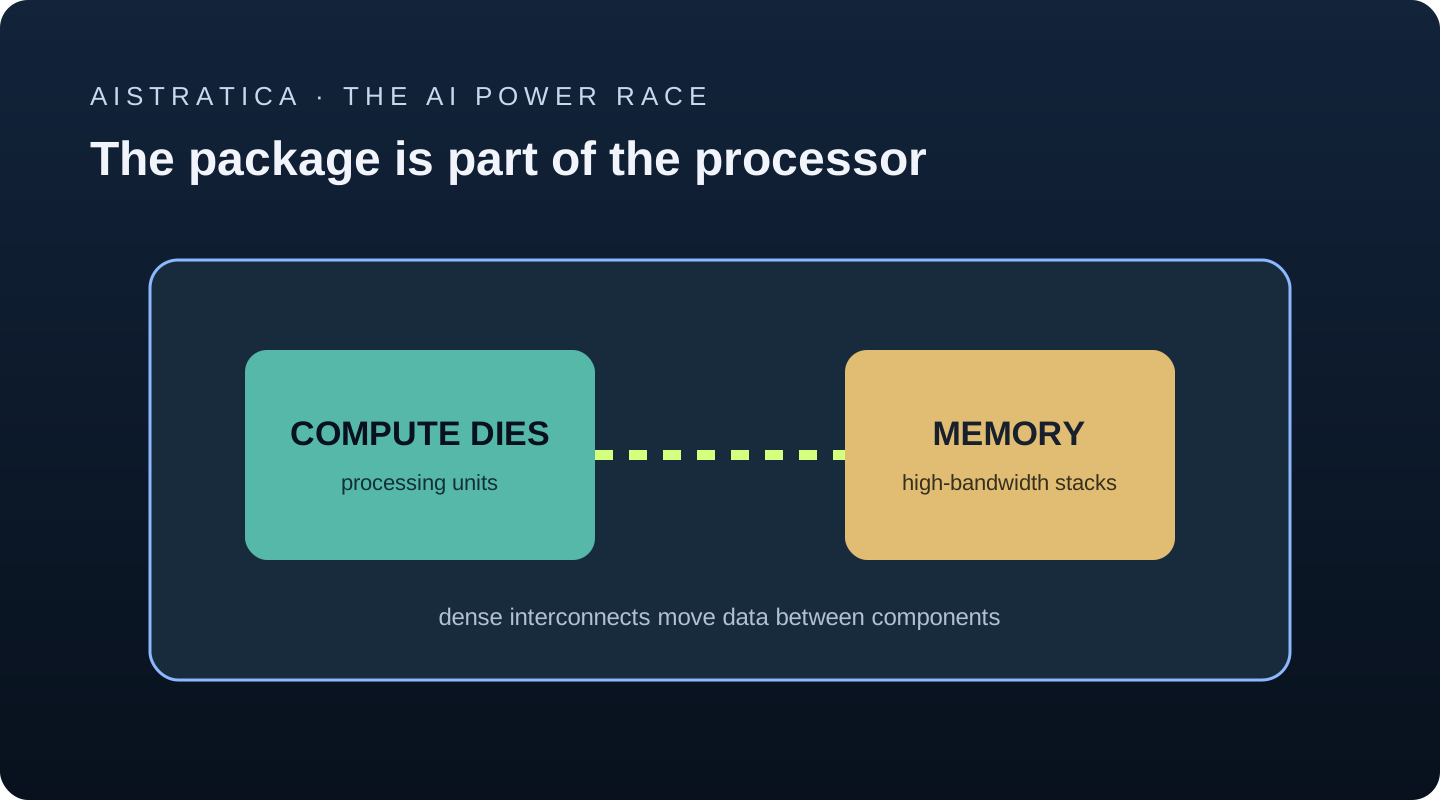
Advanced packaging joins separate pieces of silicon—such as compute dies and high-bandwidth memory—inside one system. Shorter, denser connections can move data faster and use energy more efficiently than sending it across a larger board. This matters because an AI accelerator spends much of its time moving data between processors and memory, not simply performing arithmetic.
Think of a busy airport. A faster aircraft helps, but it cannot move passengers if gates, baggage handling or runway slots are full. In an AI chip, a leading-edge processor is the aircraft; packaging capacity is part of the gate and connection system that lets the processor and memory operate as a unit. Buying a faster plane while the gates are full is an expensive way to admire the timetable.
Packaging is not a simple substitute for more wafers. Advanced packages rely on a chain of inputs and processes: suitable compute dies, memory stacks, substrates, bonding and interconnect equipment, inspection, testing, engineering know-how and qualified production lines. A shortage at any stage can slow a finished accelerator. More package capacity also does not guarantee customers will receive every component they need; supply chains rarely offer a one-click ‘complete system’ button.
The market read-through
The week’s clearest demand signal is AMD’s nearly doubled data-center revenue. It shows that accelerator and server demand is translating into sales for a major supplier beyond Nvidia. But one quarter cannot tell us how much of the growth is durable, how concentrated orders are among a few customers, or what margins and delivery schedules will look like as capacity expands.
The investment signal is more structural. AMD’s Taiwan commitments and ASE’s new facility point to a build-out measured in years, not weeks. Reuters’ reporting suggests chip designers are also exploring additional suppliers and panel-based processes. Those approaches may eventually broaden capacity, but the timelines cited for new facilities and production mean they are not immediate relief valves.
For investors and technology buyers, the distinction between announced investment, construction, qualified production and volume output matters. A press release may describe a planned facility; it does not mean the facility is already producing high-yield packages for a specific accelerator. A ribbon-cutting photo is not a shipment schedule. Nor does a new process become a drop-in replacement simply because it can fit more chips on a panel in principle. Customers have to qualify performance, reliability and yields.
The market is also exposed to a concentration problem. TSMC dominates leading advanced packaging for high-performance AI systems, according to Reuters’ reporting. Diversifying among suppliers could reduce dependence on one production route, but each alternative needs equipment, skilled labour, customer qualification and reliable upstream inputs. Building a second route is therefore a supply-chain strategy, not a quick procurement switch.
The investment cycle has a timing problem
Capacity investments are made against demand that may change before a plant is ready. A facility announced today can take years to construct, equip, staff and qualify. In other words, a capacity announcement is a promise about a future production line, not an extra lane opening tomorrow morning. Meanwhile, AI chip designs evolve quickly. Packages are getting larger and more complex, and a line designed around one generation of products may need adjustment for the next. Suppliers therefore face a difficult balance: invest early enough to win customers, but avoid building expensive capacity that sits idle if orders shift or customers change designs.
This helps explain why customers and suppliers may share the cost or risk of expansion. A chip designer wants enough packaging slots to meet its own delivery plans; a supplier wants evidence that expensive equipment will be used. Long-term supply agreements, reserved capacity or customer financing can align those incentives. They can also create concentration: a line tailored to one major buyer may be less useful to competitors, and smaller customers may find themselves behind the largest buyers in the queue.
The current numbers need to be read at the right level. AMD’s $8.5 billion data-center segment is a reported revenue figure across a portfolio that includes CPUs and accelerators; it is not a measure of packaging purchases. The more than $10 billion AMD announced for Taiwan is an ecosystem investment plan, not a single packaging-factory budget. ASE’s NT$17.6 billion facility is a company-announced project with a stated completion target, not current production. And Yole’s estimate of nearly $28 billion in advanced-packaging capital spending is an industry forecast. These figures point in the same direction, but they are not interchangeable measures of demand or output.
That distinction matters to market interpretation. When announcements are counted as if they were completed capacity, readers can mistake future supply for present relief. The useful milestones to watch are construction progress, equipment installation, customer qualification, yield improvement and actual shipment volumes. Until those appear, the story is one of commitments and bottlenecks rather than a sudden flood of new AI processors. The factory floor, sadly, does not run on press-release dates.
What it means for the AI power race
The U.S.–China technology competition is often reduced to who can design the most advanced accelerator or obtain the most computing power. Packaging adds a supply-chain layer to that picture. A country or company may have chip designs and access to fabrication, yet still depend on a limited number of firms for advanced assembly, memory integration and testing.
For Taiwan, capacity expansion can bring investment and reinforce its position in the global AI stack, while increasing the strategic importance of a supply chain concentrated on the island. South Korea and Japan matter through memory, materials and equipment; the United States and Europe contribute design, equipment and customers. Diversification attempts could create opportunities for other locations, but the public plans discussed this week are not evidence that production has already shifted away from Taiwan.
China’s packaging market: real progress, but not full parity
China belongs in this story as both a growing market and a serious packaging competitor. Its large domestic electronics and semiconductor base, government-backed investment and demand from local chip designers give Chinese suppliers room to build capacity and learn by serving home-market customers. JCET, one of China’s leading outsourced semiconductor assembly and test (OSAT) companies, reported RMB 27 billion in 2025 revenue associated with advanced packaging, alongside continued investment in high-end capacity. That is evidence of a substantial and expanding business; it is not a measure of AI accelerator packaging alone, nor does revenue by itself prove equivalent yields or performance to the most advanced global lines. (JCET’s 2025 results)
So, can China match advanced packaging? In some functions and for some workloads, increasingly yes; across the frontier at comparable scale and reliability, the public evidence does not yet support a yes. Chinese firms have established 2.5D and 3D capabilities and are using multi-die integration to improve domestic AI systems. The Research Institute for Democracy, Society and Emerging Technology (DSET) describes Huawei’s Ascend 910C as using a dual-die architecture and argues that packaging can combine China’s best available domestic dies into “good-enough” system-level compute. That can matter for domestic training and inference even when an individual chip does not match a leading Nvidia accelerator. (DSET’s June 2026 analysis)
The remaining gap is about the whole production system, not whether Chinese firms can produce an advanced package at all. DSET identifies engineering challenges in interconnect precision, warpage and thermal management, alongside dependence on some high-end materials and equipment. It also notes that China has not yet achieved high-end, mass-production substitution for several packaging materials. The comparison with Taiwan’s leading CoWoS ecosystem therefore needs to consider package type, production volume, yield, memory availability, qualification and delivery—not just a lab demonstration or a headline capacity number. A technically credible package is progress; a repeatable, high-yield line supplying large volumes of complete AI systems is a higher bar.
China’s market position is consequently asymmetric: it may expand “good-enough” domestic compute and reduce exposure to foreign packaging routes without matching every frontier product or supplier ecosystem. That is commercially meaningful and strategically relevant, but it does not erase constraints in leading-edge logic, high-bandwidth memory, software, or system integration. The fairest read is neither “China cannot do advanced packaging” nor “China has caught up”: China can compete and substitute in selected packaging pathways, while frontier-scale parity remains unproven and bottlenecks persist.
The security-dilemma lens also calls for restraint. Capacity expansion can serve commercial goals—meeting customer orders, improving yield and earning returns—as well as national industrial strategies. It is not, by itself, evidence of preparation for military use or a direct response to export controls. Strategic competition shapes the environment, but the evidence here is primarily about business demand, production bottlenecks and supply-chain risk.
What we still do not know
Several important details remain uncertain. Reuters’ account of Nvidia financing SPIL relies on an unnamed source and has not been publicly confirmed by the companies. Yole’s $28 billion spending figure is a forecast, and its scope and assumptions matter. Company announcements describe investment plans, but do not disclose the eventual share of output allocated to specific customers. Finally, packaging capacity is only one part of the system: memory supply, fabrication, power, networking and data-center construction can each become limiting factors.
TSMC’s October monthly sales are scheduled for release on 10 November, after this briefing’s cutoff. This edition therefore uses no October sales figure and makes no claim about live or current share prices. The next useful check is whether company disclosures translate planned spending into completed lines, qualification milestones and shipments.
AIstratica’s Market Lens
This week, the AI infrastructure story moved one stage deeper into manufacturing. AMD’s results show strong current demand; the investments announced by AMD and ASE show that suppliers are preparing for greater complexity and volume; Reuters’ reporting indicates that limited advanced-packaging capacity is already shaping industry decisions, while one high-profile financing report remains unconfirmed.
The market implication is not a prediction about which chip stock will rise. It is a reminder that AI capacity depends on a chain of specialised steps. The next competitive advantage may come not only from designing a faster processor, but from producing, packaging, testing and delivering complete systems at scale. The glamorous chip still needs a very competent backstage crew.
Sources and verification
- AMD, “AMD Reports Third Quarter 2026 Financial Results,” 3 November 2026.
- Reuters, “AI boom turns chip packaging into the next battleground for semiconductors,” 6 November 2026.
- AMD, “AMD Announces More Than $10 Billion in Taiwan Ecosystem Investments to Accelerate AI Infrastructure,” 21 May 2026.
- ASE Holdings, “K18B Groundbreaking Ceremony: Strengthening Our Competitiveness in Advanced Packaging,” 2025 announcement; facility completion was scheduled for Q1 2028.
- JCET Group, “JCET Releases 2025 Annual Report,” 9 April 2026.
- Research Institute for Democracy, Society and Emerging Technology (DSET), “The Great Breakout: Advanced Packaging and China’s Race for AI Compute Parity,” 4 June 2026.
Editorial note: Company financials and plans are identified as company-reported; the industry spending figure is attributed to Yole via Reuters; the Nvidia–SPIL financing is explicitly unconfirmed. This is industry analysis, not investment advice.