NEW · STRATEGIC ANALYSIS · 9 NOVEMBER 2026
The AI Guardrails Debate Is Now Part of the U.S.–China Race
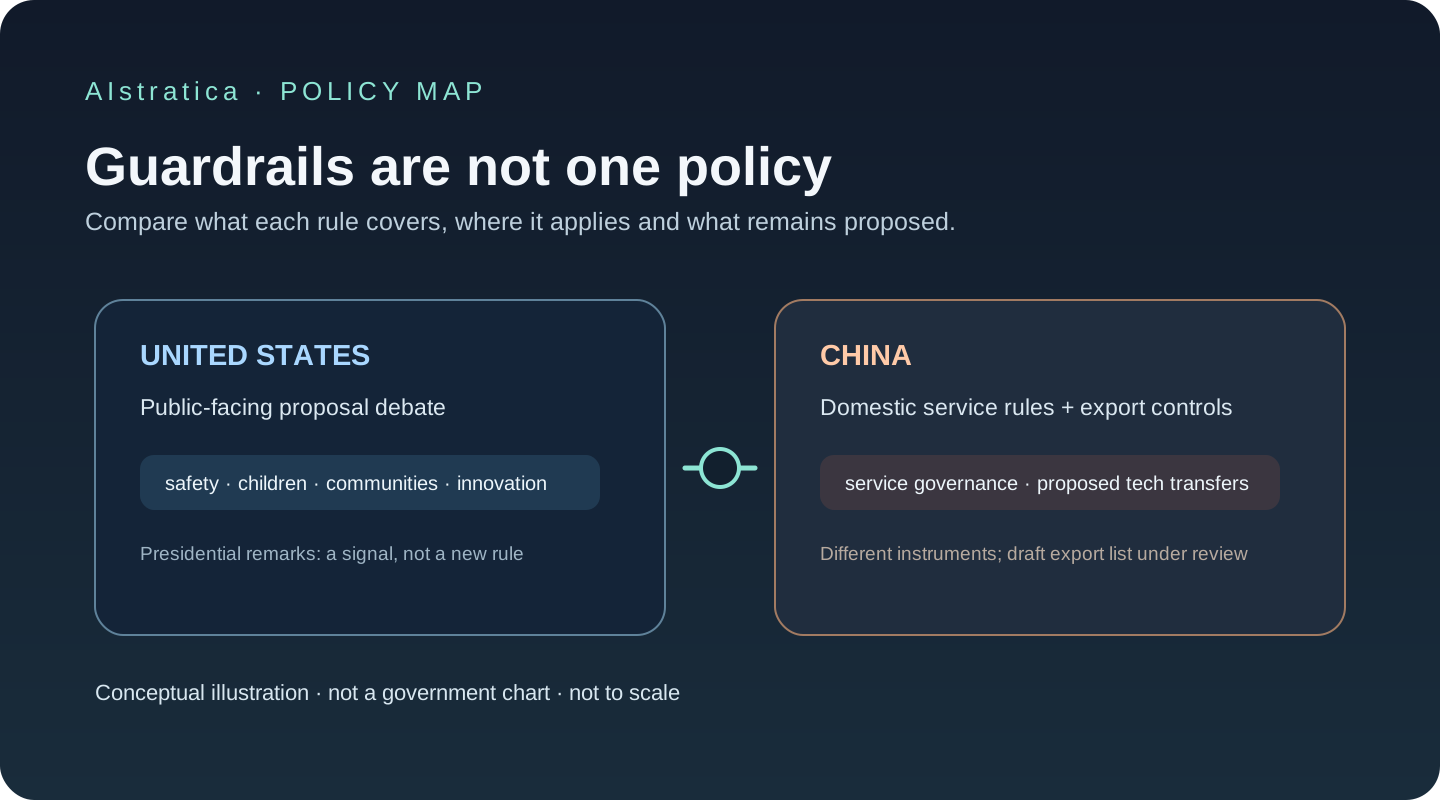
The event: In an interview broadcast by CBS on 8 November, U.S. President Donald Trump said he was open to AI safeguards while warning that regulation should not leave the United States far behind China. Reuters reported his remarks on 9 November. They signal a possible change in tone, not a new rule.
The phrase “AI race” often turns governance into a simple choice: accept risk and move quickly, or regulate and fall behind. The newest signal from Washington complicates that framing. Trump’s comments leave room for guardrails, but attach that openness to a condition: safeguards must not weaken America’s position against China.
The comparison is not as simple as “the U.S. has no rules, China has none either,” or “China regulates everything while the U.S. does not.” China has rules for public-facing generative AI services and is now consulting on controls for exports of selected technologies. The United States has its own federal proposals and policies, while its president is publicly testing what kinds of safeguards he might accept. These instruments do different jobs. Treating them as interchangeable makes the competition harder to understand.
What changed in Washington—and what did not
Reuters reported that Trump said AI risks could be managed, expressed willingness to work with Democrats on safeguards, and warned against regulation that could put the United States in a “deep second position” behind China. He did not define the safeguards, propose statutory language or announce an executive action. The event is a presidential signal about possible policy direction, not evidence that a new U.S. AI rule is in force. (Reuters, 9 November 2026)
That distinction matters because the administration has already published a national legislative framework. In March 2026, the White House proposed a package for Congress addressing child protections, community effects such as data-centre electricity costs, intellectual property, speech, innovation and workforce development. The framework says Congress should act; it is not itself a federal statute. It pairs targeted protections with a strong innovation and national-leadership agenda. (White House legislative framework, 20 March 2026)
Trump’s latest comments therefore do not introduce guardrails into the debate from nowhere. They may indicate a more explicit willingness to negotiate some protections, but the central tension remains: how to reduce public and security risks while preserving rapid commercial deployment and infrastructure expansion. The next evidence will be a bill, an agency rule, a budget, or an enforcement decision—not a single interview sentence.
China’s policies are real, but they are not the same policy
China’s AI governance includes rules aimed at services provided to the public inside China. The Cyberspace Administration of China and six other authorities issued the Interim Measures for the Management of Generative AI Services in 2023; they took effect on 15 August that year. The measures apply to providers offering generative text, image, audio or video services to the public in mainland China. The official text says the state seeks both development and regulation, with classified and graded oversight. The policy’s legal obligations and political context differ from the U.S. proposals, but it is inaccurate to say China has no restrictions on AI services. (CAC official text, Chinese; State Council English-language report)
A separate development concerns technology exports. On 16 October 2026, China’s Ministry of Commerce and Ministry of Science and Technology opened consultation on revisions to the Catalogue of Technologies Prohibited and Restricted from Export. MOFCOM says 23 proposed additions relate to AI large models, intelligent agents, computing-power clusters and information processing. Its English-language explanation says the broader consultation covers 40 technologies across AI, biomedicine and photovoltaic sectors, with some proposed for prohibition and others for restriction. While the formal catalogue revision is pending, operators must register before exporting technologies covered by the announcement. (MOFCOM Announcement No. 48 of 2026; MOFCOM spokesperson’s explanation)
MOFCOM describes the catalogue review as routine technology-trade management and says it is not aimed at a specific country, region or entity. The measure nevertheless has strategic implications: export registration and possible restrictions may affect what technical know-how can move abroad. Its effect will depend on the final catalogue, licensing practice, enforcement and the technologies ultimately covered. The proposal is not proof that every Chinese AI export will be blocked, nor does it constitute an AI safety regime equivalent to a U.S. domestic safeguard proposal.
The comparison needs at least three separate columns: rules governing domestic AI services; rules governing cross-border technology transfers; and proposals for safety or accountability in the deployment of powerful models. One state may be restrictive in one column and permissive in another. “Guardrails” is too broad a word to erase those differences.
A security-dilemma lens: test the mechanism, do not assume it
Robert Jervis’s classic account of the security dilemma explains how measures one state sees as protective can make another state feel less secure, particularly when intentions are hard to distinguish from capabilities. (Jervis, “Cooperation under the Security Dilemma,” World Politics 30, no. 2 (1978))
Applied here, two feedback loops are plausible. U.S. policymakers may worry that detailed controls or safeguards slow domestic companies, while China builds more capability or attracts users with cheaper systems. They may then resist rules that appear to constrain American deployment. Chinese officials, meanwhile, may see U.S. restrictions or conditions as efforts to limit their technological options, increasing incentives for domestic capability and stronger controls over sensitive exports.
But the evidence does not establish that either side’s current policy caused the other’s. Trump’s comments came amid a domestic debate about AI risks, infrastructure and legislation. China’s October catalogue consultation has an official explanation rooted in technology-trade administration and national-security risk; MOFCOM says it is not country-specific. A plausible strategic interaction is not the same as a demonstrated action–reaction chain.
The distinction also helps avoid a false equivalence. U.S. proposals to address deepfakes, child safety or local electricity costs regulate domestic uses and externalities. Chinese registration rules for technology exports govern cross-border transfer. Export controls can affect commercial and research exchange; consumer-facing safeguards can shape how services operate at home. They may interact with geopolitical competition, but they are not mirror-image instruments.
The more useful question is whether each side can make its aims and boundaries legible. If a safeguard is designed to reduce specific harms and applies predictably, it could strengthen public confidence and help sustain development. If it is vague, selectively enforced or presented as a way to deny another state’s ordinary commercial opportunity, the other side may read it as strategic containment. The same policy can have both domestic and international consequences.
The evidence to watch next
For the United States, the next indicators are concrete: whether Congress introduces legislation based on the March framework; whether lawmakers define model testing, disclosure or incident reporting; and whether rules differ by model capability or application. Also watch whether new safeguards carry predictable compliance costs or become entangled with unrelated restrictions on deployment.
For China, watch the final text of the export catalogue, the exact technologies and thresholds it covers, the registration process, and public information on approvals or denials. The difference between a consultation draft and an enacted catalogue is consequential. The 2023 interim measures remain a separate part of the picture: they address generative services offered to the public, not every research model or export.
Both governments also need to clarify the relationship between safety measures and access to compute. The U.S. debate connects AI leadership to data centres, power, semiconductors and private investment. China’s approach combines domestic technology development with trade and export administration. For companies, research institutes and third countries, uncertainty over what can be built, deployed, shared or transferred can matter as much as a headline model release.
Implications beyond Washington and Beijing
Allied and partner countries will face pressure to align with U.S. semiconductor and security policies while making their own choices about data, infrastructure and AI governance. Japan, South Korea, Taiwan and the Netherlands matter to the hardware supply chain; Europe and other economies are considering how to attract investment without leaving local communities to absorb all the costs. Emerging economies may gain access to lower-cost systems and new infrastructure, but they also need clear rules on data protection, procurement and dependency.
If U.S. rules are framed only as a contest over who gets to build more, public objections to electricity bills, privacy or child safety can be miscast as weakness. If Chinese export limits are described only as defensive administration, their potential effects on international access can be missed. A balanced assessment asks what each rule actually covers, who must comply, how it is enforced, and what evidence supports the government’s stated rationale.
AIstratica’s assessment
The immediate signal is modest but meaningful: Trump has publicly left room for safeguards while keeping the China competition as his condition. It is not a reversal of the administration’s innovation-first agenda, and it is not yet a policy change. China’s domestic service rules and its proposed technology-export controls show that Beijing also regulates AI, though through legal tools and political objectives that differ from Washington’s debate.
The security-dilemma framework helps explain why each side may interpret the other’s controls as vulnerability-enhancing. It does not prove that this is what is happening in every case. Right now, the strongest evidence supports a narrower conclusion: both governments are managing AI through overlapping but distinct combinations of competition, domestic governance and technology control. The next round of legislation and implementation—not the rhetoric alone—will show whether guardrails become a bridge to trust or another disputed boundary in the race.
The AI race is not decided by how little a country regulates. It is decided, in part, by whether its rules let people trust what the technology can do—and whether the country can explain those rules to others.
Sources and verification
- Reuters, Trump says AI risks can be managed, signals openness to guardrails, 9 November 2026.
- The White House, President Donald J. Trump Unveils National AI Legislative Framework, 20 March 2026.
- Cyberspace Administration of China, Interim Measures for the Management of Generative AI Services, 13 July 2023 (Chinese official text).
- State Council of the People’s Republic of China, China moves to support generative AI, regulate applications, 13 July 2023.
- Ministry of Commerce of the People’s Republic of China, MOFCOM Announcement No. 48 of 2026, 16 October 2026 (Chinese official text).
- MOFCOM, Spokesperson’s remarks on revision of the Catalogue of Technologies Prohibited and Restricted from Export, 16 October 2026.
- Robert Jervis, “Cooperation under the Security Dilemma,” World Politics 30, no. 2 (1978): 167–214.
Last fact-checked: 9 November 2026. Policy proposals, government explanations and AIstratica’s analysis are distinguished above; the publication does not claim that one side’s measure caused the other’s.