NEW · STRATEGIC ANALYSIS · 8 NOVEMBER 2026
What the 2026 U.S. Midterms Mean for the AI Industry
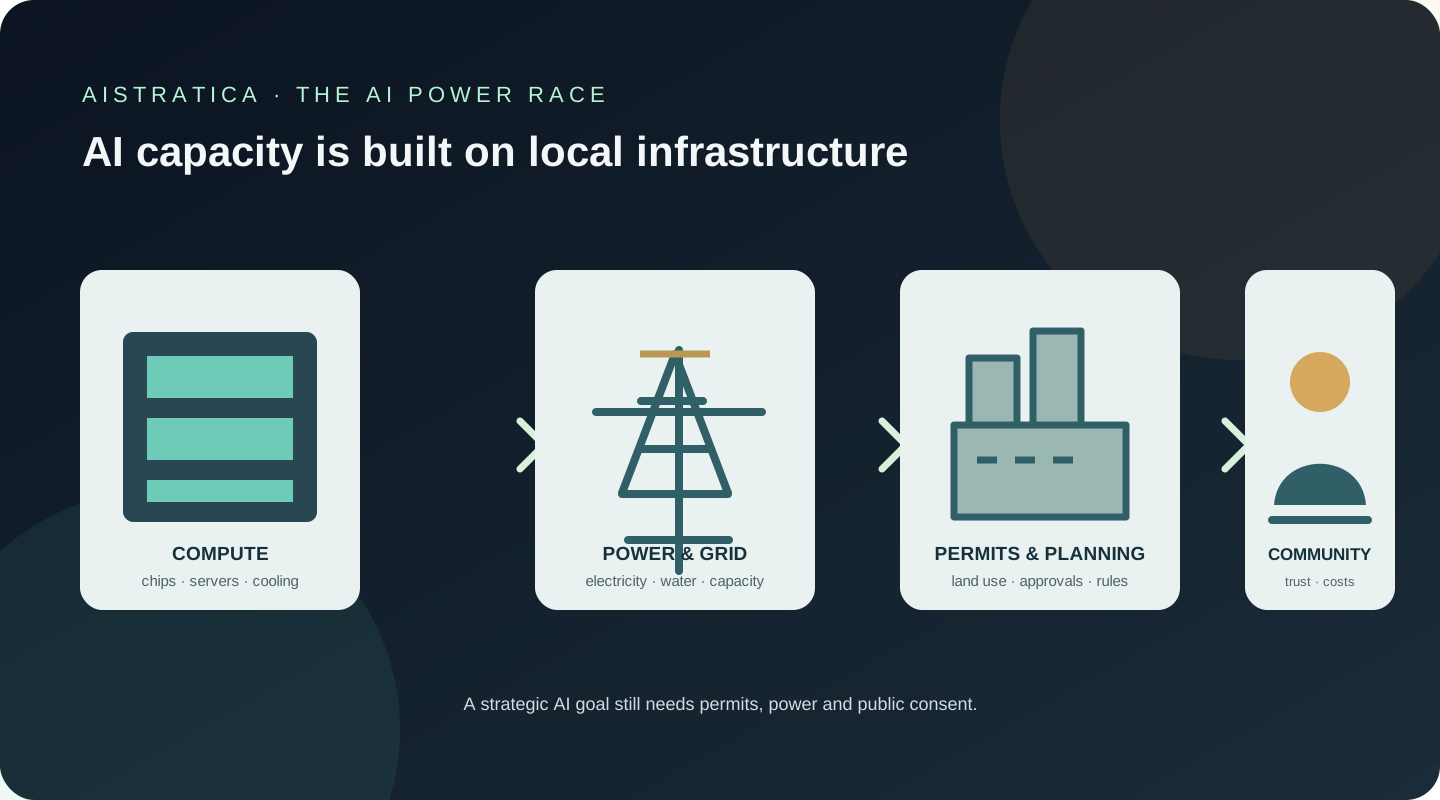
The midterm ballot was still being counted when one story became clear: the future of artificial-intelligence infrastructure had become a local political issue. Voters considered zoning, land use and data-centre proposals while the national election reshaped Congress. The result does not decide whether the United States will lead in AI. It does sharpen a question the industry can no longer avoid: who pays for the infrastructure that leadership requires?
What the election changed—and what it did not
On 3 November 2026, voters elected a new Congress, governors and local officials. CBS News projected that Democrats would take control of both the House and Senate, with the new Congress beginning in January 2027. The transition leaves the current Congress and administration in place in the meantime. Democratic control is likely to increase congressional oversight capacity, but divided government can make major legislation harder to enact, especially when the president opposes it. CBS News results coverage · PwC’s post-election policy analysis
The election did not produce a new federal AI statute or automatically stop data-centre construction. Nor did voters cast a single national verdict on artificial intelligence. Rather, local votes and candidates’ positions made the physical footprint of AI infrastructure more visible.
Ballotpedia’s review found voters favoured limiting data-centre development in 40 of 41 local ballot contests held on 3 November. That figure covers different kinds of outcomes: 27 measures directly limited development or expressed opposition, while other results rejected proposals that would have enabled or supported projects. Some votes were advisory rather than binding. Calling all 40 results “data-centre bans” would overstate the evidence. Ballotpedia’s election summary
The political signal is still notable. The Associated Press reported that 32 of 34 victorious gubernatorial candidates in races where AP had called a winner supported stronger regulation or restrictions; 12 supported bans or moratoriums. AP also reported that data centres were not a top issue for most voters, even as many communities expressed opposition to projects nearby. The result is best understood as a meaningful local and state pressure, not a national referendum on AI. Associated Press analysis
Why the data centre has become an AI policy issue
A data centre is a building full of computing equipment, but its footprint reaches beyond the building. It needs electricity, cooling, water systems, transmission connections and land. Large facilities may be proposed in places that were not previously major centres of electricity demand.
The International Energy Agency has documented growing community and policy-maker concern about data centres’ effects on electricity prices, emissions and water. It also describes a planning problem: proposed connection queues may contain duplicate or speculative projects, while demand is difficult to predict. Underestimate demand and grids may be unprepared; overestimate it and utilities risk building capacity that is stranded or underused. IEA, Powering Artificial Intelligence
Berkeley Lab’s 2025 U.S. data-centre energy report estimates that data centres could account for 11.8% of total U.S. electricity use by 2030, with scenarios ranging from 9.5% to 15.3%. These are modelled estimates, not a guaranteed outcome. The range reflects uncertainty about how many projects proceed, when servers are installed, and how facilities are operated. Lawrence Berkeley National Laboratory report
For a resident, the question is not only the national share of electricity used by AI. It is whether a nearby project affects household bills, water supplies or local planning—and whether the community receives a fair share of the benefits. AP reported that Texas candidates spoke to concerns around water and local resources, while the election of officials critical of data-centre projects raised the prospect of stronger conditions in key development markets. AP report
Evidence and interpretation at a glance
| Development | What the evidence establishes | What it does not establish |
|---|---|---|
| Democrats projected to control both chambers in 2027 | Congress’s oversight and committee landscape is expected to change | That a specific federal AI bill will pass or that federal data-centre policy has already changed |
| Voters favoured limits in 40 of 41 local ballot contests | Local opposition to the tested proposals was broad; the measures took different forms | That all results were binding, or that every project in the United States will be blocked |
| AP reported many winning governors backed stronger restrictions | State-level scrutiny may increase in several markets | That campaign positions will become law or apply identically across states |
| IEA and Berkeley Lab document fast-growing demand and planning uncertainty | Power, grid connections and forecasting are real infrastructure constraints | That AI demand will reach one exact forecast, or that elections caused the underlying demand |
The strategic problem for U.S. AI
The industry and policymakers face two aims that can collide.
First, the United States wants to expand computing capacity. More infrastructure can support advanced-model training and deployment, commercial services and research. AI capacity also sits within Washington’s wider technological competition with China.
Second, expansion must be physically and politically workable. Projects facing permitting disputes, uncertain grid access or community opposition may become slower and more expensive. A “build faster” strategy that ignores local costs can create backlash; a strategy that cannot secure power and permits cannot deliver the capacity companies announce.
This tension is not uniquely American. The IEA’s review of policies in more than 34 jurisdictions describes efforts to improve visibility of data-centre demand and require projects to contribute to generation adequacy or grid stability. It reports that operators signed 45 terawatt-hours of power-purchase agreements in the first half of 2026, nearly 20% more than in the same period of 2025, with close to 70% in the United States. Power contracts and grid integration are becoming part of the infrastructure contest. IEA analysis
That suggests a broader measure of AI competitiveness. The question is no longer only who can obtain leading accelerators or train the largest models. It is also who can coordinate chips, power generation, transmission, storage, project approvals and public trust at scale.
Could this create an action–reaction cycle?
The election’s relationship to U.S.–China competition should be stated carefully. American controls on advanced semiconductors and manufacturing equipment have sought to constrain certain Chinese capabilities. China has invested in domestic capacity and adapted to hardware limits. The midterm outcome does not itself alter those export controls. Its immediate effect is domestic: it may make parts of the U.S. infrastructure expansion more politically contested.
One plausible response is more investment in efficiency, flexible computing, private power, grid upgrades or locations with clearer approval pathways. These are possibilities to watch, not proven results of this election.
The security-dilemma lens helps frame the stakes without treating every local protest as a geopolitical act. A government that sees compute capacity as essential to economic and security interests may regard delay as a vulnerability. Yet efforts to accelerate construction may intensify public concerns about electricity, water or who pays. If new restrictions follow, policymakers may interpret the resulting limits as a threat to national competitiveness and seek new ways to build.
That is an analytical possibility, not a causal finding. Local opposition has direct explanations—resource use, land, utility costs and trust—and available evidence does not show that U.S.–China rivalry caused the votes. Nor is every U.S. restriction on technology aimed only at containing China. Industrial policy, commercial incentives, domestic politics and military requirements also shape decisions.
Why the rest of the world should pay attention
U.S. infrastructure choices can affect global AI supply chains. Data centres rely on international semiconductor, memory, networking, cooling and electrical-equipment markets. If U.S. projects are delayed or redirected, demand and investment could shift among regions and suppliers. That is a likely channel of influence, not evidence that one country will automatically gain a strategic lead.
Allied economies face related choices. Japan, South Korea, the Netherlands and European states are connected to key parts of the semiconductor and equipment supply chain, while also weighing energy, industrial and environmental policies at home. Emerging economies may benefit from new infrastructure investment, but they must consider grid readiness, cost allocation and long-term dependence on external providers.
The policy question is not simply whether to welcome or reject data centres. It is what conditions make projects useful to host communities: transparent resource estimates, credible power plans, fair treatment of ratepayers, public consultation and a clear account of local benefits.
What firms and policymakers may do next
Five responses deserve attention in 2027:
- More disclosure: Developers may be asked to report projected electricity and water use and expected effects on local infrastructure.
- Different cost arrangements: Regulators may scrutinise how grid upgrades are assigned, to avoid households subsidising private projects.
- Clearer permitting: Communities may demand public hearings, zoning standards or approval requirements. More predictable rules could help projects in some places even as other locations close their doors.
- New energy arrangements: Companies may pursue power-purchase agreements, on-site generation, storage or demand flexibility. Each involves trade-offs in cost, emissions, reliability and construction time.
- Geographic sorting: Investment may cluster in areas with available power and clearer approval pathways, leaving other regions with fewer projects.
Reuters reported after the election that greater oversight, protections for utility ratepayers and stricter energy and pollution reporting could gain attention. These are possible policy directions, not enacted federal rules. Reuters analysis
Communities also face trade-offs. Data-centre investment can bring tax revenue, construction activity and related manufacturing investment. Those benefits do not resolve questions about water, power or who pays. AP reported both industry arguments that communities could miss out on revenue and candidates’ promises to impose new conditions or moratoriums. AP report
What to watch in 2027
The election’s long-term effect will depend on what elected officials do, not only what they said during the campaign. Watch whether state moratorium proposals become law; whether local measures create binding restrictions or remain advisory; how regulators assign the cost of new generation and transmission; and whether developers make verifiable commitments to host communities.
Also watch how companies respond. Do they improve compute efficiency, adapt workloads to grid conditions and invest in new power capacity? Or do they simply move projects to jurisdictions with fewer restrictions? The answer will shape both where AI infrastructure grows and how much public confidence it retains.
Stronger rules could slow some projects but give developers more predictable expectations and communities more confidence. Lighter rules could accelerate construction in the short term but leave unresolved disputes about costs and resource use. Outcomes will vary by place.
AIstratica’s assessment
The midterms did not decide who will lead the global AI race, and local ballot votes were not a blanket rejection of AI. They did make one part of the race harder to ignore: advanced computing requires physical infrastructure, and that infrastructure must coexist with local energy systems and communities.
The security-dilemma connection in this article is AIstratica’s interpretation of how national capacity goals can interact with domestic infrastructure constraints. The election evidence shows increased political pressure; it does not prove that U.S.–China competition caused local opposition. For the semiconductor side of the competition, see our Research Spotlight on U.S. restrictions and Chinese technological adaptation and the AI Market Lens briefing on export controls and investment.
The United States can continue investing heavily in AI. But capacity will depend on more than investment announcements: firms will need power, permits and a credible account of who benefits and who pays.
The next test of AI ambition may happen at a town hearing about a power line, a water plan or a zoning map. The race is still global—but some of its consequential decisions are local.
Source note: Event results and policy claims checked against CBS News, Ballotpedia, AP, Reuters, the IEA and Berkeley Lab on 8 November 2026. Ballot results include both measures that directly imposed limits and outcomes rejecting proposals that would have supported development; some were advisory. Analysis and forecasts are identified as such.